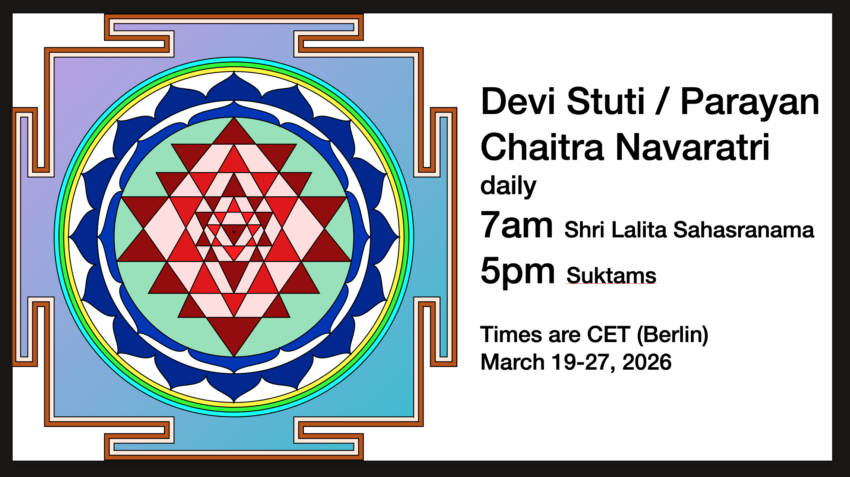
During Navaratri (literally: nine nights) , the many forms of Devī, from Lalitā to Durgā to Kālī, are celebrated and honoured and chanting is intensified.
For those who are tired of religion telling women to be ever pleasant, subservient and in the background, a special invitation: From Nondual perspective, Devī is the living manifestation of the one consciousness. Ritually speaking (and these are by no means mutually exclusive), she is the one who sets boundaries, wields wrath as a sacred weapon when her colleagues fail to deliver, and may not be reduced to some simplistic interpretation. She is revered for her power, and her ability to destroy the destructive, including fear itself. Constructs of “ideal femininity” shatter against her complexity, which encompasses wrath, excess, and protection.
The hymn Devī Māhātmyam describes her benevolent brutality in all conceivable and inconceivable detail. The terrible and magnificent aspects of the Goddess are neither moral nor “maternal” in a conventional sense, nor are they any “counterpoint” to gentleness and kindness. They are expressions of the same truth. Devī is whole and, in any case, beyond our categories. And because she is the whole, she has nothing to lose. In this spirit:
Program: Live Stream, March 19–27
Warm invitation:
Daily YouTube Livestream: youtube.com/@PranavaChanting

Daily at 7 AM (CET; Berlin): Śrī Lalitā Sahasranāma, the thousand names of the Goddess Lalitā Tripurasundarī.
Daily at 5 PM (CET; Berlin): Various Vedic and Purāṇic hymns/praises to forms and aspects of Devī (Medhā Sūktam, Durgā Sūktam, etc.).
Access: Open recitation.
All are invited to participate; as for their practice (for those who chant along), as sound bath, for meditation, or contemplation.
Lalitā Sahasranāma: The Thousand Names
Every morning at 7 AM, we chant the intricately woven thousand names of Lalitā Tripurasundarī. This hymn is Purāṇic and belongs to the Śākta Tantra tradition. It describes how the Goddess appears, what she can do, her cosmological functions, and her nature as consciousness itself. It is particularly heartening that the hymn is both dualistic and Nondualistic at once. Descriptions of her power, deeds and attributes repeatedly culminate in names that present her as the One that pervades everything, and from whose play (līlā) we perceive creation.
Devī-Stutis: Hymns to the Incomprehensible
At 5 PM, various shorter hymns in praise of further forms of Devī.
On Chanting
Traditional Sanskrit chanting is an art form that is simply accessible through listening. It has an immediate effect which words cannot easily describe (and don’t need to). The term for this is sāttvika: settling, clarifying, purifying inner dissonance, uplifting in every sense of the word.
The rules for chanting are mathematical, tonal, and partly ritualistic. Grammar and Śikṣā (phonetics, rules for correct pronunciation and intonation) inherently contain the conditions for undistorted transmission. Thousands of years of oral tradition have been possible through an understanding of the metrics, dramaturgy, and citation rhythms across the great hymns of the Vedas.
Chanting and singing have little in common. Singing is wanting to sound good. Chanting is speaking with mother. Chanting is free of pretense, performance, or wanting to deliver beautiful tone. It is authentic, immediate, and unguarded like a protest chant, and in temples often quite loud. In expression, chanting is actually closer to metal than to other forms of song, minus the intent to convey something. Ideally, it is only expression, precisely framed by rules. More on Vedic chanting in future posts, perhaps.
Parāyaṇa means a complete recitation; a form of devotional and/or contemplative practice. In some traditions, chanting the Sahasranāma is considered a complete practice. In many ashrams and temples, it is a regular part of the program.
But answers don’t lie in words anyway, as much as in experience. May Navaratri be such an opportunity.
Wishing you beautiful celebrations and happy holidays!